
Timber Talk 5/19/2026

OFA Update
2026 Forestry Day Recap

The Ohio Forestry Association’s 2026 Legislative Reception marked meaningful growth and momentum for our industry, bringing together 107 attendees—up from 71 in 2024. Member engagement increased with 21 OFA members and employees participating, alongside 22 legislators and approximately 30 legislative staff, reflecting stronger connections and growing interest in forestry issues at the Statehouse.
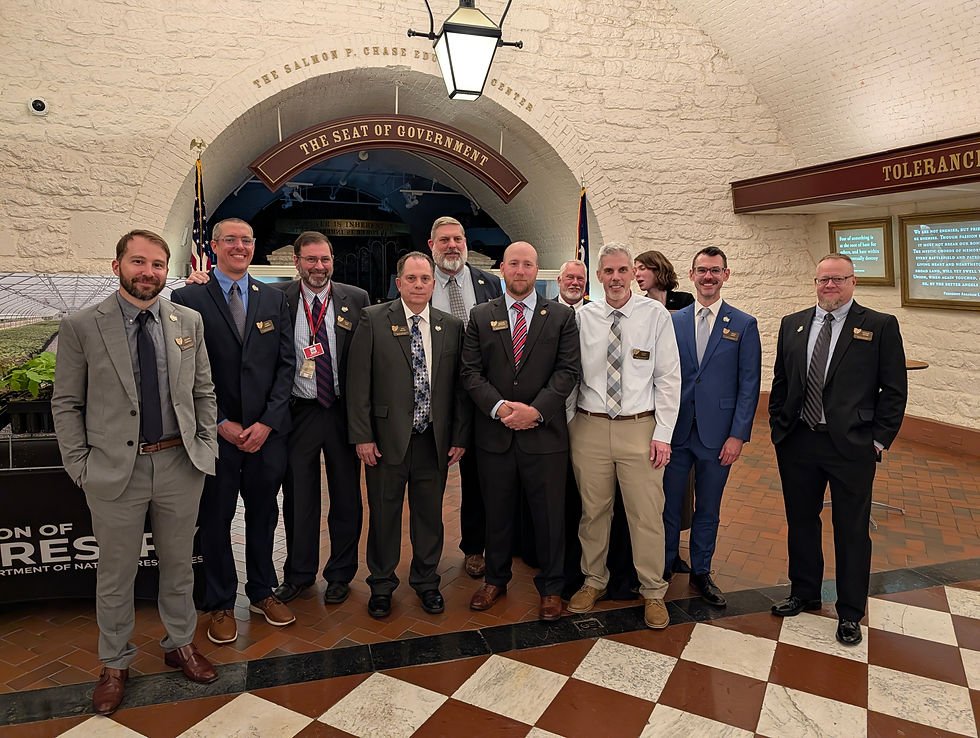
We were also encouraged by strong participation from agency partners and stakeholders across Ohio’s forestry community, and we are especially grateful to ODNR Director Mary Mertz and ODA Director Brian Baldridge for their time and support. This growth is a positive step forward, and OFA will continue working to expand both member and legislative involvement to strengthen advocacy for Ohio’s forest products industry.
Be sure to join us next year!
Camp Canopy Registration closes May 29th

Associations, SWCD offices, and other organizations across the state have generously offered sponsorship funds to help cover camp costs for those who need it. Camp Canopy will happen from June 7-12th at the beautiful FFA Camp Muskingum in Carrollton, Ohio, and registration closes on May 29th. Students completing 8th-12th grade this year can register for this week long experience that focuses on everything from forest products and tree identification to wildlife management and geology. Inquire with OFA at info@ohioforest.org for help securing a camp sponsorship.
Lumber Grading and Kiln Drying Courses

Registration is open on the OFA events page for Summer short courses available at discounted rates for OFA members. We are asking all interested members to register ASAP and help spread the word so that these courses do not have to be cancelled and we can keep offering them in the future.. All classes are multi-day events that run until 4pm each day at Yoder Lumber in Millersburg, Ohio. View the calendar to see full details and to get registered. Email OFA's Director of Forestry Programs, William Ray, at william@ohioforest.org if you have additional questions.
Market Update
HardwoodReview Forecasting
Nearly one-third of the way through the year, hoped-for increases in hardwood lumber demand are still to come. Certain distribution markets and smaller secondary manufacturers are quite busy, but larger-volume sales are on hold pending clearer indication of market direction for the remainder of the year…which can’t come until the Middle East situation is resolved, though the stock market does seem to be carrying on regardless. Lumber buyers don’t want to risk bringing in too much inventory and sawmills can’t afford to carry much more. That stalemate is keeping production low enough to support prices despite the weak demand, especially for the uppers. As anticipated, the return to somewhat normal trade relations with China has not brought back “normal” hardwood lumber shipments.
While hope remains for better grade lumber demand later this spring and summer, sawmills are now struggling with slowing in low-grade markets, with ties, crane mats and even pallet cants said to be slowing, though most of the current concern centers on ties. Add to that, reports indicate that Vietnamese-sawn Walnut, from U.S. logs, is now competing with U.S.-produced lumber in Asian and German markets, a trend that could very well expand into other species and markets at the rate log exports are growing.
Legislative Update
The following is brought to us by our national partner, the Forest Resources Association (FRA)
Surface Transportation Reauthorization Update
On Thursday, House Transportation Committee Chair Sam Graves (R-MO-06) indicated he didn’t expect to hold a markup of the next surface transportation bill, previously scheduled to take place on May 20. This is expected to push back the release of the bill's text. Committee staff has kept details of the package tightly held, but we understand that a briefing for committee members’ legislative assistants is tentatively planned, during which staff will walk through major provisions of the reauthorization bill. The minority has not yet signed off on the measure; if that impasse continues, the timeline for consideration may slip again to allow for further negotiations.
We remain optimistic that truck‑weight reform language (Safe Routes) will be included in the underlying bill. As always, we will keep you apprised of developments as they unfold.
Renewable Fuel Standard (RFS)
As we have reported, an amendment to the Farm Bill reauthorization measure that passed the House a couple of weeks ago, which would have broadened the definition of “renewable biomass” so that fuels derived from woody biomass could qualify for the RFS, failed narrowly on the House floor. The effort continues in the Senate, where we have learned that Senate Agriculture, Nutrition, and Forestry Committee Chairman John Boozman (R-AR) is working closely with Senator Jeff Merkley (D-OR) on compromise definitional language to help build support for this effort. An agreement on the exact language has not yet been reached, but we understand the focus is on federal lands and on building protections for “old growth” and timber stands in other sensitive areas of our country’s federal forest holdings. The goal is to reach an agreement on language and to include a provision in the Senate’s Farm Bill reauthorization measure. Again, the situation is fluid, but we will keep you posted. FRA remains neutral on this effort.
Forest Management and Wildfire Priorities in the FY27 Interior Budget Hearing
During a House Natural Resources Committee hearing on the FY27 Interior Appropriations bill, members focused on wildfire and forest‑health challenges. Chairman Westerman stressed the urgency of restoring forest health amid record‑low Western snowpack and 44 million homes in the Wildland-Urban Interface (WUI), praising the administration’s alignment with the Fix Our Forests Act tools, such as a Wildland Fire Intelligence Center, expanded categorical exclusions, and emergency authorities to increase the pace and scale of forest management. He also highlighted the importance of timber to rural economies and emphasized that responsible forest management is central to stewarding natural resources for future generations. Secretary Burgum emphasized Interior’s core role in “fighting fires” and highlighted the proposal to consolidate all federal wildfire programs—including Forest Service firefighting—into a unified U.S. Wildland Fire Service to eliminate silos and improve response. Committee questioning focused on wildfire readiness, pre‑positioning of assets, and the implications of transferring Forest Service firefighting, as well as NEPA permitting and ESA issues such as gray wolf management. A copy of the hearing transcript is available here.
TREE Act Introduced – EUDR undertones
Last week, the Trade Responsibly for Environmental Emissions (TREE) Act (HR 8744) was reintroduced by Rep. Lloyd Doggett (D-TX-37). The legislation is an EUDR-like proposal that would prohibit trade in interstate commerce of commodities and derived products from lands affected by deforestation or forest degradation. The list of cosponsors is virtually identical to the list of Members of Congress who signed a letter in April to the European Commission advocating for the text and implementation timeline of the EUDR to remain unchanged.
House Committee to Review Public Lands Bills
A seven‑bill public lands package is scheduled for a May 21 hearing to expand forest access for timber, road construction, and fuels‑reduction work. Key bills include:
H.R. 7695 (Hageman) — Nullifies the 2001 Roadless Rule and requires road construction on National Forest System lands for restoration, fuels reduction, and habitat management.
H.R. 8682 (Downing) — Streamlines salvage‑logging environmental review on BLM lands (up to 5,000 acres).
H.R. 8688 (Hurd) — Allows tree‑density modification projects under 5,000 acres to bypass detailed environmental assessments.
Forest Service invests $80 million in Forest Legacy conservation projects
The U.S. Forest Service today announced $80 million in FY2026 funding for 15 congressionally approved Forest Legacy Program projects, conserving approximately 34,000 acres of privately owned working forests across multiple states.
“The Forest Legacy program makes critical investments in working forests with state partnerships to provide timber supplies and other wood products, provide public access for recreation, secure drinking water, and maintain wildlife habitat in some of the most important forests across the nation,” said Forest Service Chief Tom Schultz.
Safety Update
Sedgwick Safety Services
Ladder Safety at Work
Ladders are common, useful tools in many workplaces, including construction sites, warehouses, offices, retail spaces and maintenance environments. While ladders may seem simple and harmless, they are involved in many workplace injuries every year. Falls from ladders can result in serious injuries such as fractures, head injuries and even fatalities. So, it is important to practice proper ladder safety which is essential for creating a safe work environment and preventing avoidable accidents. OSHA has Standards on ladder safety for General Industry (29 CFR 1910.23) and Construction (29 CFR 1926.1053).
Common Causes of Ladder Accidents
Many ladder-related injuries occur due to improper use. Common causes from improper use include using the wrong type of ladder for the task, placing ladders on unstable surfaces, climbing while carrying tools, overreaching and failing to maintain three points of contact. Additionally, lack of training and rushing to complete tasks also increase the risk of falls. Employers should take the time to train employees on these actions and how they can cause injuries.
Choosing the Right Ladder
A critical component of ladder safety is selecting the appropriate ladder for the job. There are several types of ladders, including step ladders, extension ladders, and fixed ladders, each designed for specific uses. For example, it is important to choose a ladder that is tall enough to reach the working height without standing on the top rung or step or in some cases the top two steps. Ladders must also be rated to support the worker’s weight plus any tools or materials being carried. Weight ratings, often labeled as “duty ratings”, should always be checked before use. Also, ladders should be made of materials suitable for the anticipated work environment. For example, nonconductive fiberglass ladders should be used when working near electrical sources, as metal ladders can conduct electricity and increase the risk of electrocution.
Inspecting Ladders Before Use
Before using a ladder, workers should perform a thorough inspection. This includes checking for cracks, dents, loose or missing rungs, damaged rails, faulty locking mechanisms as well as areas on the ladder that may cause a slip (grease, water, oils, etc.). Step ladders should open fully with spreaders locked in place, and extension ladders should have secure rope, pulleys and rung locks. Any ladder that shows signs of damage must be taken out of service immediately and repaired or replaced, otherwise, it could result in an injury.
Proper Ladder Setup
Proper ladder placement is essential for stability and for the safety of the employees using them. Ensure ladders are placed on firm, level surfaces. If a ladder must be used on uneven ground, use the appropriate leveling equipment, never use improvised solutions like bricks or boards. For extension ladders, a general rule is to place the base one foot away from the wall for every four feet of ladder height. The top of the ladder should extend at least three feet above the landing surface when used to access roofs or elevated work platforms.
Ladders should never be placed in front of doors that are not locked or guarded, as unexpected opening can cause the ladder to fall. Barricades or warning signs should be used when ladders are set up in high-traffic areas.
Safe Climbing and Working Practices
When climbing a ladder, workers should always maintain three points of contact. Three points of contact is where the employee places either two hands and one foot or two feet and one hand on the ladder at all times. It is very important to face the ladder while climbing and descending as this will help maintain balance and control. Tools and materials should be carried using either tool belts or hoisted with a rope, as ascending or descending a ladder while holding equipment can result in a fall. Finally, never have more than one person on a ladder as this could stress the maximum capacity of the ladder and could result in instability, unless the ladder is designed for multiple users.
Training and Awareness
Effective ladder safety requires proper training and reinforcement. Employees should be trained on items such as ladder selection, inspection, setup and safe use. Regular safety talks and refresher training are great ways to keep safety at the forefront of workers’ minds. Employers also play a key role in ladder safety by setting clear expectations, correcting unsafe behaviors consistently and ensuring ladders are used appropriately.
Conclusion
Ladder safety is a critical component of workplace safety and should never be overlooked. By choosing the right ladder, inspecting it before use, setting it up correctly and following safe climbing practices, workers can significantly reduce the risk of falls and injuries. Employers and employees share responsibility for ensuring ladder safety through proper training, awareness and adherence to safety guidelines. Taking the time to use ladders safely protects not only individual workers but also the overall health and productivity of the workplace.
If you would like to know more about Sedgwick’s safety services or would like to schedule a confidential consultation, please contact Andy Sawan at andrew.sawan@sedgwick.com or 330-819-4728.
Additional News and Links
Sedgwick Safety Article
NEOFA Newsletter
ECOFA Newsletter
SOFA Newsletter
Upcoming Events
Wednesday, May 27, 2026 |
Sunday, June 7, 2026 |
Monday, June 15, 2026 |
Lumber Grading Short Course 2026 6/15/2026 » 6/18/2026 Location: Millersburg, Ohio Time: 8:00 - 4:00 Daily |
Tuesday, July 28, 2026 |
7/28/2026 » 7/30/2026 Location: Millersburg, Ohio |
Friday, October 2, 2026 |
2026 Paul Bunyan Show RETURNING Exhibitor Registration 10/2/2026 » 10/4/2026 Location: Lore City, Ohio Time: 8:00-5:00 Fri/Sat 9:00-3:00 Sun |
2026 Paul Bunyan Show Food Vendor Registration 10/2/2026 » 10/4/2026 Location: Lore City, Ohio Time: Friday & Saturday 8 am - 5 pm, Sunday 9 am - 3 pm |
OFA Proudly Supports RAHC


Comments